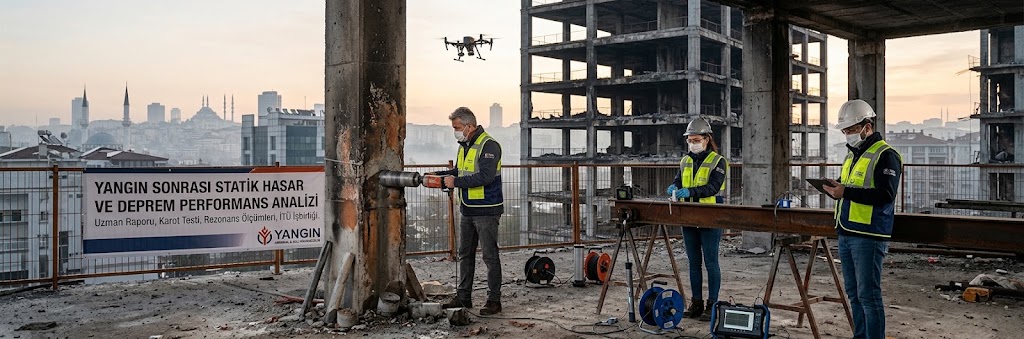
Post-Fire Structural Integrity Assessment
Determination of the damage a fire leaves in a building's structural strength through core sampling, Newton hardness testing, and vertical/horizontal resonance measurement. An expert opinion, backed by academic collaboration, on demolition, partial demolition, or reinforcement.
The Fire Being Out Doesn't Mean the Risk Is Over
A fire reaching 1,200–2,000°C leaves invisible damage in a reinforced-concrete structure's static strength. Fire scene analysis establishes the cause of the fire; this service answers the question that comes next: is the building fit for continued use after the fire is suppressed, fit for partial use, or not fit at all? Our expert team determines the building's remaining strength scientifically through vertical and horizontal structural measurements.
Field Measurements and Academic Laboratory Analysis Process
The critical operational steps carried out in the field and laboratory to establish the real damage a fire has left in a building are as follows:
Determining Fire Severity and Spread Profile
The floor where the fire started (roof, mid-level, or ground floor), the time it took to extinguish, and the type of material that burned (a textile fire and a petroleum- or alcohol-based fire do not leave the same fire load) are the first data points that determine which part of the building was affected and to what extent. A fire that starts on a mid-level floor of a 17-story building, for instance, puts the entire upper structure at risk, while roof fires usually remain localized.
Core Sampling and Newton Hardness Testing
Core samples are taken from fire-exposed load-bearing columns and beams; surface and interior hardness is tested with Newton measurement devices to mathematically calculate the compressive strength the concrete has lost.
Vertical/Horizontal Resonance Measurement and Academic Validation
Vertical and horizontal resonance (oscillation) measurements are taken on load-bearing columns to determine the structure's remaining load capacity. All data collected is analyzed academically in civil and earthquake engineering research laboratories at Istanbul Technical University (İTÜ) and supported with a structural visualization before being turned into the final expert report.
Why Have a Post-Fire Structural Integrity Assessment Done?
Every decision made without this report is a guess: should the building be fully demolished, only the damaged floor, or is reinforcement enough? For an owner looking to re-lease, an independent expert report is the one concrete document that reassures a hesitant tenant; the same report prevents loss of legal rights in sale and insurance processes as well.
"In short: post-fire structural integrity assessment measures the real strength left in the concrete and steel beneath the ash, turning the demolition, reinforcement, or continued-use decision from a guess into a scientific determination."
- Service Duration
- Depends on building size (avg. 4–8 days)
- Reporting
- Expert-witness standard, backed by academic collaboration
- Coverage
- All of Turkey