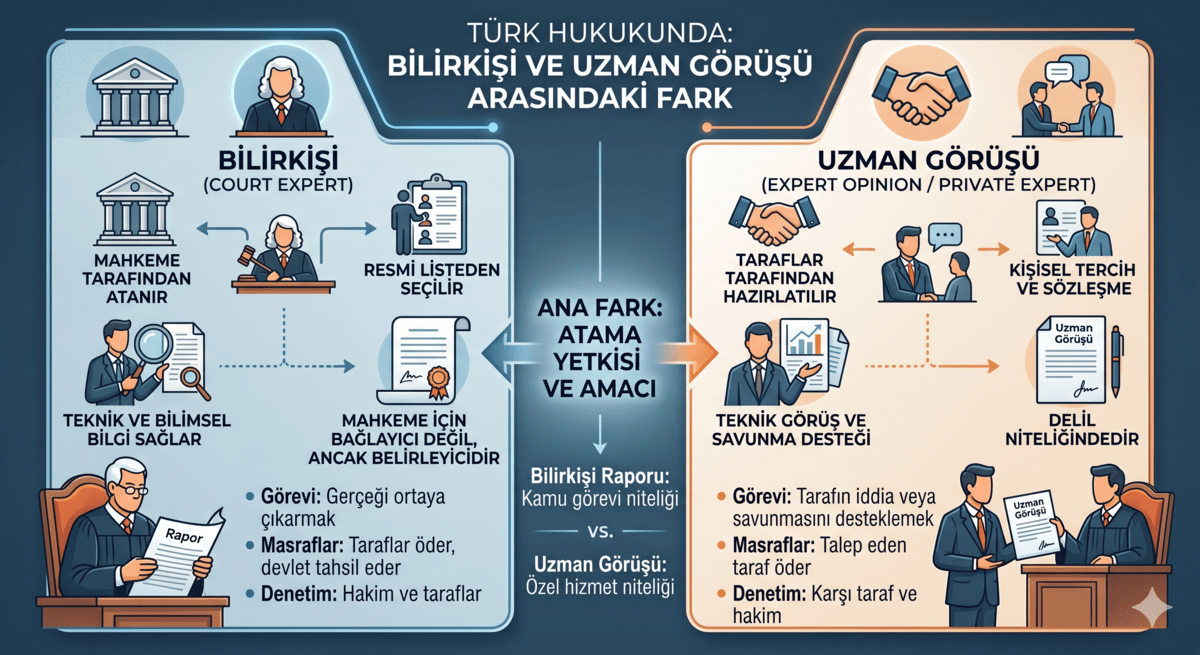
Defining the Roles in Judicial Proceedings
In our legal system, scientific opinions are sought to resolve complex matters requiring technical expertise. The two most commonly confused concepts here are the roles of the 'Bilirkişi' (court-appointed expert) and the 'Uzman' (independent expert providing an expert opinion/mütalaa). Although both roles provide technical knowledge, their legal standing before the court, method of appointment, and the legal weight of their reports are entirely different.
Who Is the Bilirkişi (Court-Appointed Expert)? (The Court's Impartial Eye)
A bilirkişi is an impartial technical professional whose opinion the judge or court decides to obtain in matters requiring special or technical knowledge to resolve.
Appointed directly by the court (judge) or the prosecutor's office, selected from official bilirkişi lists prepared by the justice commissions of the courts of first instance.
Must be entirely impartial. Acts as an extension of the court. Maintains equal distance from all parties and bears criminal liability (imprisonment) for making false statements.
The report they prepare enters the case file directly as an official 'Bilirkişi Report.' The judge relies heavily on this report when reaching a decision.
Who Is the Uzman (Independent Expert)? (Party Representative and Technical Reviewer)
An uzman (a person providing an 'Expert Opinion / Mütalaa' under Article 293 of Turkey's Code of Civil Procedure) is a technical expert privately retained by one of the parties to a case, to support their claims or defenses before the court with a scientific basis.
Not appointed by the court. Freely selected and retained by one of the parties to the case (plaintiff or defendant) or their legal representatives (attorneys).
Investigates the scientific validity of the claims of the party who requested the service. However, while bound by scientific ethics, forms the technical arm of an adversarial defense mechanism.
The 'Expert Opinion' they prepare is not treated in court as a bilirkişi report directly; however, it is a very powerful piece of 'substitute evidence' and a component of the claim or defense that is submitted to the court and technically/scientifically reviews the official bilirkişi report.
Key Differences and Comparison
To clarify the line between the two titles, the operational and legal differences can be summarized as follows:
A bilirkişi can only be appointed by public authority (a judge/prosecutor acting on behalf of the state), whereas an uzman is retained and paid for directly by the parties to the case.
If an official bilirkişi report contains a flawed, incomplete, or unscientific assessment, the most effective way to refute it before the court and persuade the judge is to submit an academic and technical 'Expert Opinion' to the file.
Bilirkişi are sworn in before the court before beginning their duty and are legally considered 'public officials.' A person providing an independent expert opinion, by contrast, bears the responsibility of their own scientific competence and signature.