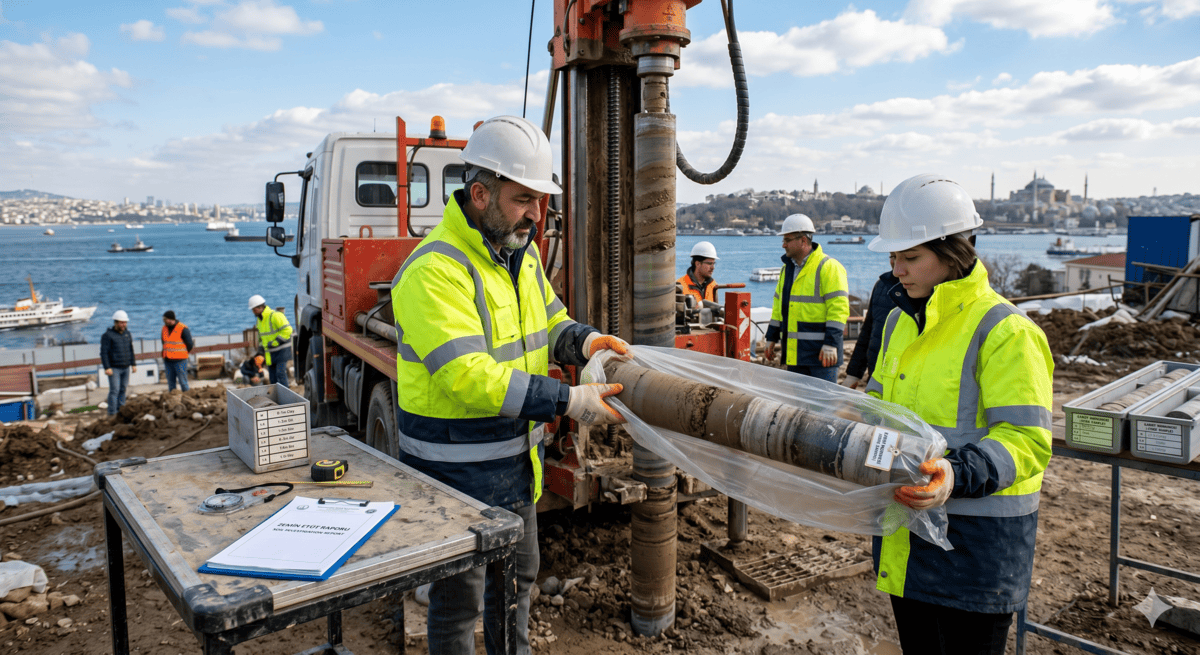
Core Drilling & Soil Survey
Concrete core sampling, compressive strength testing, and geotechnical soil mechanics investigations to assess building seismic safety.
The Role of Concrete and Soil Parameters in Structural Safety
Core drilling and soil survey are the two most fundamental soil- and structural-engineering steps that determine both a building's current strength and its resilience against future disasters. It is not only the quality of the superstructure (the reinforced-concrete elements) that matters — how the ground beneath the building responds to seismic waves is equally vital. Our expert geology, geophysics, and civil engineers use field boreholes and precision core-cutting equipment to analyze the building's risk profile at the micro level, from foundation to roof.
Field Operations and Laboratory Testing Process
The core operations carried out in the laboratory and in the field to establish the physical condition of the building and the ground with clear, unalterable data are as follows:
Professional Core Cutting and Structural Safety
Cylindrical concrete samples are taken with specialized diamond-tipped core-cutting machines from carefully chosen points that will not damage the building's load-bearing elements. The resulting cavities are immediately filled with high-strength structural repair grout to preserve the building's load-bearing integrity.
Field Boreholes and Soil-Mechanics Laboratory Analysis
Seismic borehole drilling is carried out to specific depths on-site to establish the soil profile and collect samples. Sieve analysis, Atterberg limits, and triaxial compression tests conducted in our accredited laboratory mathematically calculate the soil's bearing capacity, settlement risk, and liquefaction potential.
Seismic Geophysical Measurements (MASW / ReS)
Using artificial ground vibrations and geophysical instruments, the velocity of seismic P- and S-waves (Vs30) is measured. These measurements allow us to precisely locate loose soil layers that could amplify the load transferred to the building during an earthquake.
Why Obtain Core Drilling and Soil Survey Services?
It is impossible to determine visually how strong a building's concrete really is, or whether the ground beneath it will behave like a liquid during an earthquake (soil liquefaction). In urban-transformation applications, building damage assessments, or property-sale disputes, the only way to obtain the conclusive technical data legally recognized and required by the Ministry of Environment, Urbanization and Climate Change and judicial authorities is through this integrated pair of studies.
"In short: core drilling and soil survey are a scientific check-up that reveals a building's skeletal structure and the character of the ground it stands on. A secure future is built on solid ground backed by accurate engineering data."
- Service Duration
- Field work 1–2 days (avg. 3–5 days including laboratory)
- Reporting
- Compliant with TBDY, the Ministry of Environment, Urbanization and Climate Change, and Forensic Norms
- Coverage
- All of Turkey