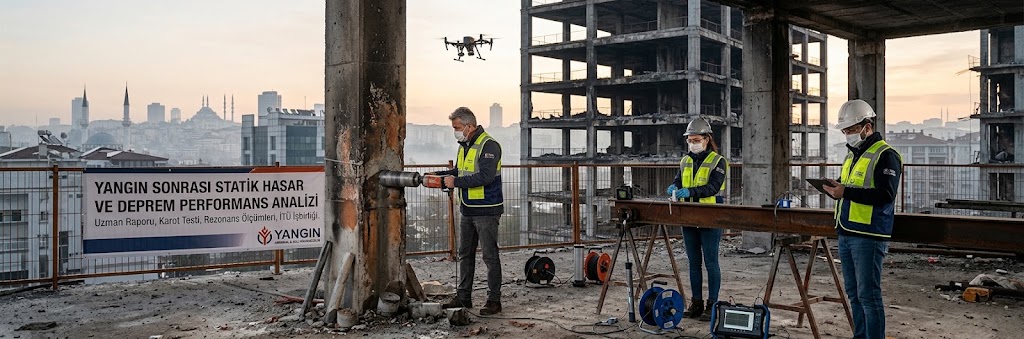
When the Fire Goes Out, the Real Question Begins
Once the fire department leaves the scene, the danger can look over. In reality, the uncertainty for the building starts right there. A structure that appears to be standing intact may be carrying a loss of strength in its load-bearing system that is invisible to the eye. This article explains, technically, how that loss is measured and what decisions it leads to.
Fire's Invisible Effect on Concrete and Steel
A fire reaching 1,200–2,000°C leaves permanent, often invisible, changes in a building's materials:
As moisture inside the concrete vaporizes under intense heat, it causes surface explosions (spalling), reducing the concrete's compressive strength by an amount that isn't visible to the eye.
Above a certain temperature, steel reinforcement loses its elasticity and load-bearing capacity — and this loss remains even after the steel cools.
A textile fire and a petroleum- or alcohol-based fire do not leave the same damage in the same duration; the fire load of the burning material directly determines the intensity of the heat generated.
Why the Floor Where a Fire Started Matters More Than Its Size
In a 17-story building, a fire that starts on the roof usually stays localized and can be isolated quickly. But a fire that starts on the second floor of the same building can weaken the structure's middle section, putting every floor above it at risk. This is why the floor of origin — as much as the size of the damage — determines the scope of a demolition decision: damage at the ground floor can threaten the entire building, damage at a mid-level floor threatens the floors above it, and damage at the roof usually affects only that floor.
How Is It Measured, and How Is the Decision Made?
Core samples are taken and tested with Newton hardness testing to calculate the concrete's remaining compressive strength; vertical and horizontal resonance measurements are taken on load-bearing columns to determine the structure's oscillation behavior. Analyzed in civil and earthquake engineering research laboratories at Istanbul Technical University (İTÜ), this data turns into a clear expert opinion: that the building doesn't need to be demolished at all, that only the damaged section needs partial demolition, that it needs to be fully demolished, or that it can be made usable again through reinforcement.