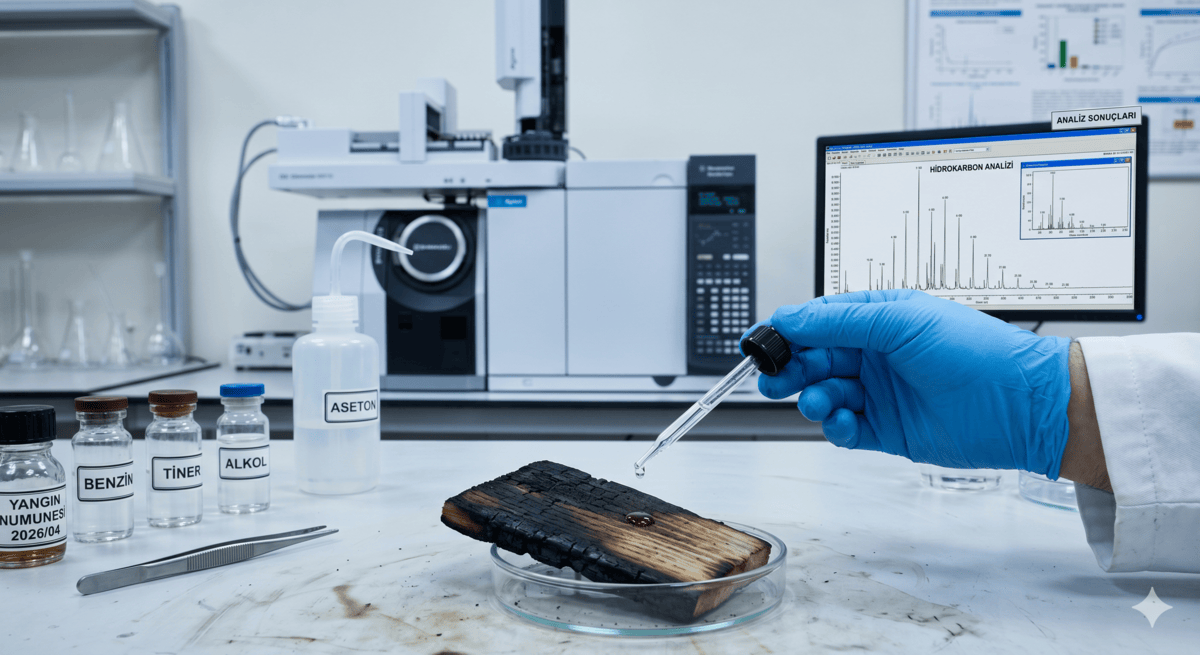
What Is an Accelerant and Why Is It Analyzed?
In acts of arson, liquid or gaseous flammable chemicals such as gasoline, diesel, thinner, alcohol, kerosene, or lighter fluid are typically used to make a fire grow rapidly, spread out of control, and cause maximum damage to a structure. These substances are referred to in fire-investigation literature as an 'accelerant.' Fire forensics scientifically proves the element of intent (sabotage) by searching for the microscopic traces of these substances hidden within ash and soot.
Field Work: Collecting Samples
The success of laboratory analysis depends on taking the right sample from the scene using the right technique. Despite the intense heat at a fire scene, porous surfaces can preserve accelerants:
Experts collect samples from wood-floor cracks, beneath carpets, behind baseboards, porous areas of concrete, and the deepest points of V-pattern burn marks — because liquid substances seep into these areas under gravity and escape complete combustion due to the lack of oxygen at the base.
Collected evidence is never placed in plastic bags, because accelerants are volatile and can react with plastic. Instead, specially lined, airtight metal cans (arson cans) or nylon-free polymer bags that reduce chemical volatility to near zero are used.
The Laboratory Stage: The Gold-Standard GC-MS
Evidence that reaches the laboratory undergoes analysis with state-of-the-art instruments recognized worldwide as the 'gold standard' in forensic chemistry:
The metal can is gently heated to release the volatile substances within the sample as a gas into the can's headspace. This gas is absorbed with a special fiber-optic needle (SPME) and injected into the instrument for separation.
The mixture entering the instrument is passed through a very thin, long tube (column). The chemical substances in the mixture exit the tube at different times (retention times) based on their molecular weight and boiling point, fully separating from one another.
The separated molecules are bombarded with electrons and fragmented into ions. Every chemical substance has a unique 'mass spectrum fingerprint,' just like a human fingerprint. This makes it possible to determine with 100% certainty whether the substance in the sample is gasoline, thinner, or simply ordinary furniture polish from the room.
The Sensitivity and Legal Weight of the Analysis
Modern GC-MS instruments are so sensitive that they can detect hydrocarbon chains (fuel residues) at parts-per-million (ppm) or even parts-per-billion (ppb) levels, even in debris that has been doused with tons of water and firefighting foam and left for days.